RecA - The Bacterial Recombinase

Table of Contents

Section 1: RecA與細菌基因組維護

1.1 基本信息

蛋白質信息:

  • 基因recA (大腸桿菌染色體 58 min位置)
  • 蛋白質:352個氨基酸,~38 kDa
  • 功能形式:核蛋白絲狀體(nucleoprotein filament)
  • 發現:1965年首次基因鑒定,1980年蛋白純化

進化保守性:

  • 存在於幾乎所有細菌和古菌
  • 真核生物同源蛋白:Rad51 (體細胞)、Dmc1 (減數分裂)
  • RadA在古菌中發揮類似功能

1.2 生物學功能

DNA修復中的角色:

  • 雙鏈斷裂修復:通過同源重組修復DSB
  • 複製叉救援:修復停滯或崩潰的複製叉
  • SOS反應:DNA損傷後誘導~40個SOS基因表達

臨床與應用意義:

  • 抗生素抗性發展的關鍵(水平基因轉移)

  • 細菌進化與適應的驅動力

  • 合成生物學中的基因組編輯工具

Section 1: RecA and Bacterial Genome Maintenance

1.1 Basic Information

Protein Information:

  • Gene: recA (E. coli chromosome, 58 min position)
  • Protein: 352 amino acids, ~38 kDa
  • Functional Form: Nucleoprotein filament
  • Discovery: First genetic identification in 1965, protein purification in 1980

Evolutionary Conservation:

  • Present in nearly all bacteria and archaea
  • Eukaryotic homologs: Rad51 (somatic cells), Dmc1 (meiosis)
  • RadA performs similar functions in archaea

1.2 Biological Functions

Role in DNA Repair:

  • Double-Strand Break Repair: Repairs DSBs through homologous recombination
  • Replication Fork Rescue: Repairs stalled or collapsed replication forks
  • SOS Response: Induces expression of ~40 SOS genes after DNA damage

Clinical & Applied Significance:

  • Key player in antibiotic resistance development (horizontal gene transfer)

  • Driver of bacterial evolution and adaptation

  • Tool for genome editing in synthetic biology


Section 2: RecA介導的鏈交換經典機制

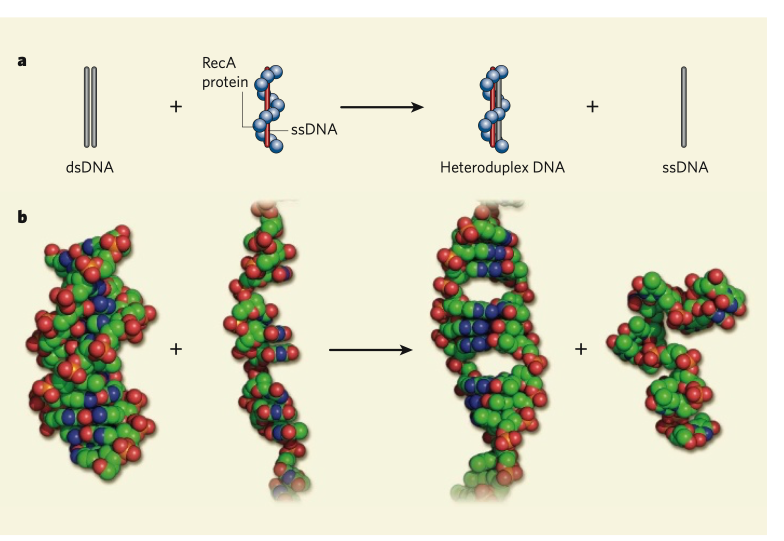
RecA介導的同源重組是一個高度有序的多步驟過程,可分為三個主要階段。

Section 2: Classical Mechanism of RecA-Mediated Strand Exchange

RecA-mediated homologous recombination is a highly ordered multi-step process that can be divided into three main stages.

RecA strand exchange mechanism

Figure 1: Schematic overview and molecular detail RecA-mediated strand exchange mechanism
Source: Kowalczykowski Nature 453, pages463–465 (2008)

2.1 三步催化循環

Step 1: 核蛋白絲狀體形成

分子事件:

  • RecA在ATP存在下結合單鏈DNA(ssDNA)
  • 形成右手螺旋的絲狀體(螺距:95 Å)
  • DNA被延伸(~1.5倍B-form長度)並解旋

關鍵參數:

  • 結合化學計量:3 nt / RecA單體
  • 解離常數(Kd):~0.1-0.2 μM(單分子測量)
  • 絲狀體生長速率:~50 RecA/秒(在飽和濃度下)

ATP的作用:

  • 促進RecA-ssDNA絲狀體組裝
  • 穩定活性構象
  • ATP水解率:~30 min⁻¹(在ssDNA上)

Step 2: 同源性搜索

機制:

  • RecA-ssDNA絲狀體通過瞬時三鏈中間體採樣dsDNA基質
  • 同源性檢測需要8-15 bp的連續配對
  • 非同源序列被快速拒絕(<1秒)

搜索動力學:

  • 三維擴散 + 一維滑動
  • 每次試探接觸的持續時間:~10-100 ms
  • 成功識別同源序列後形成穩定複合物

Step 3: 鏈交換

入侵與配對:

  • 入侵鏈與同源鏈配對
  • 形成異源雙鏈DNA(D-loop結構)
  • 置換鏈被釋放為單鏈DNA

鏈交換速率:

  • 極性:5’ → 3’(相對於入侵鏈)

  • 速率:~3-6 bp/秒

  • 可處理長達數千鹼基對的DNA

2.1 Three-Step Catalytic Cycle

Step 1: Nucleoprotein Filament Formation

Molecular Events:

  • RecA binds single-stranded DNA (ssDNA) in the presence of ATP
  • Forms a right-handed helical filament (pitch: 95 Å)
  • DNA is stretched (~1.5x B-form length) and underwound

Key Parameters:

  • Binding stoichiometry: 3 nt / RecA monomer
  • Dissociation constant (Kd): ~0.1-0.2 μM (single-molecule measurements)
  • Filament growth rate: ~50 RecA/s (at saturating concentration)

Role of ATP:

  • Promotes RecA-ssDNA filament assembly
  • Stabilizes active conformation
  • ATP hydrolysis rate: ~30 min⁻¹ (on ssDNA)

Mechanism:

  • RecA-ssDNA filament samples dsDNA substrates through transient three-strand intermediates
  • Homology detection requires 8-15 bp of continuous pairing
  • Non-homologous sequences are rapidly rejected (<1 s)

Search Kinetics:

  • 3D diffusion + 1D sliding
  • Duration per trial contact: ~10-100 ms
  • Stable complex formation after successful homology recognition

Step 3: Strand Exchange

Invasion & Pairing:

  • Invading strand pairs with homologous strand
  • Forms heteroduplex DNA (D-loop structure)
  • Displaced strand released as ssDNA

Strand Exchange Rate:

  • Polarity: 5’ → 3’ (relative to invading strand)

  • Rate: ~3-6 bp/s

  • Can process DNA up to thousands of base pairs

2.2 輔助蛋白與調控

RecA的活性受到多個輔助蛋白的精細調控:

RecBCD複合體:

  • 在雙鏈斷裂處加工DNA末端
  • 識別Chi序列(5’-GCTGGTGG-3’)
  • 將RecA裝載到適當的DNA鏈上

SSB (Single-Strand DNA-Binding Protein):

  • 保護ssDNA免受降解
  • RecA可以置換SSB結合ssDNA
  • SSB-RecA協同作用促進絲狀體組裝

RecF, RecO, RecR:

  • RecFOR途徑:替代RecBCD的另一條途徑

  • 在停滯的複製叉處裝載RecA

  • 促進RecA在SSB包被的ssDNA上成核

The classical three-step mechanism of RecA-mediated strand exchange provides the foundation for understanding how bacteria maintain genome stability through homologous recombination.

2.2 Accessory Proteins & Regulation

RecA activity is finely regulated by multiple accessory proteins:

RecBCD Complex:

  • Processes DNA ends at double-strand breaks
  • Recognizes Chi sequence (5’-GCTGGTGG-3')
  • Loads RecA onto the appropriate DNA strand

SSB (Single-Strand DNA-Binding Protein):

  • Protects ssDNA from degradation
  • RecA can displace SSB to bind ssDNA
  • SSB-RecA synergy promotes filament assembly

RecF, RecO, RecR:

  • RecFOR pathway: Alternative to RecBCD

  • Loads RecA at stalled replication forks

  • Promotes RecA nucleation on SSB-coated ssDNA


Section 3: 結構洞察:突觸複合體

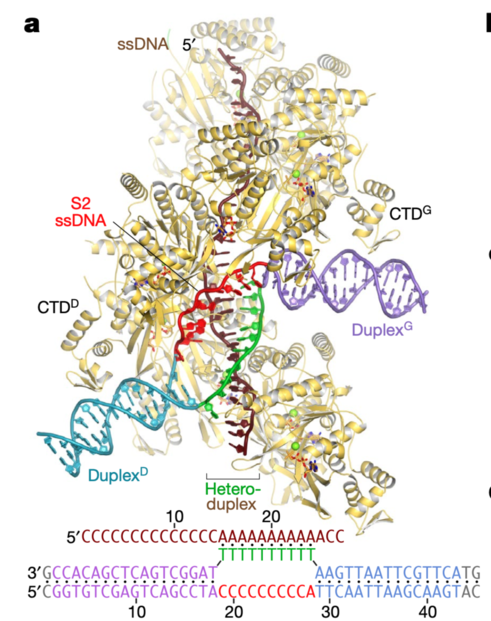
近年來高解析度冷凍電鏡(Cryo-EM)結構揭示了RecA介導鏈交換的分子細節,為理解這一精密的生物化學過程提供了前所未有的視角。

Section 3: Structural Insights: The Synaptic Complex

Recent high-resolution cryo-electron microscopy (Cryo-EM) structures have revealed molecular details of RecA-mediated strand exchange, providing unprecedented insights into this sophisticated biochemical process.

Cryo-EM structure of RecA synaptic complex

Figure 2: Cryo-EM structure of RecA-DNA synaptic complex
Source: Yang et al., Nature 586,801–806 (2020)

3.1 RecA結構域組成

RecA蛋白包含三個主要結構域:

核心ATPase結構域(Core Domain, 1-269 aa):

  • Walker A和Walker B motifs
  • ATP結合和水解的催化中心
  • 維持絲狀體結構的核心

DNA結合結構域(DNA-Binding Domain):

  • L1和L2環負責DNA結合
  • L2環(aa 195-209)在鏈分離中起關鍵作用
  • 識別DNA主溝

C端結構域(CTD, 270-352 aa):

  • 介導雙鏈DNA識別
  • 在同源性搜索中至關重要
  • 與相鄰RecA單體相互作用

3.2 三鏈複合體的幾何排列

DNA組織:

  • ssDNA延伸至B-form的~1.5倍長度
  • 每3個核苷酸與1個RecA單體相互作用
  • DNA呈右手螺旋排列(螺距:95 Å)

三鏈中間體:

  • 同時容納三條DNA鏈
  • 入侵鏈(incoming strand)
  • 同源鏈(homologous strand)
  • 置換鏈(displaced strand)

構象變化:

  • ATP結合誘導活性構象

  • 促進DNA延伸和解旋

  • 穩定三鏈中間體

3.1 RecA Domain Architecture

RecA protein contains three major domains:

Core ATPase Domain (1-269 aa):

  • Walker A and Walker B motifs
  • Catalytic center for ATP binding and hydrolysis
  • Core for maintaining filament structure

DNA-Binding Domain:

  • L1 and L2 loops responsible for DNA binding
  • L2 loop (aa 195-209) plays key role in strand separation
  • Recognizes DNA major groove

C-Terminal Domain (CTD, 270-352 aa):

  • Mediates duplex DNA recognition
  • Critical for homology search
  • Interacts with adjacent RecA monomers

3.2 Geometric Arrangement of Three-Strand Complex

DNA Organization:

  • ssDNA stretched to ~1.5x B-form length
  • Every 3 nucleotides interact with 1 RecA monomer
  • DNA arranged in right-handed helix (pitch: 95 Å)

Three-Strand Intermediate:

  • Simultaneously accommodates three DNA strands
  • Incoming strand
  • Homologous strand
  • Displaced strand

Conformational Changes:

  • ATP binding induces active conformation

  • Promotes DNA extension and unwinding

  • Stabilizes three-strand intermediate


Section 4: 超越DNA:核酸多樣性的挑戰

4.1 細胞環境的複雜性

RecA與DNA基質的相互作用已被廣泛表徵超過四十年。然而,體內環境呈現出遠比純DNA系統複雜的核酸景觀:

RNA-containing結構的普遍存在:

  • R-loops(DNA-RNA雜合體 在轉錄過程中廣泛存在
  • 複製-轉錄衝突產生含RNA的結構
  • RNA引物在DNA複製中啟動岡崎片段合成

中心問題: RecA作為一個為DNA重組優化的蛋白,如何與這些含RNA的基質相互作用?

Section 4: Beyond DNA: The Unexplored World of RNA-DNA Hybrids

4.1 The Cellular Reality Check

RecA’s interaction with DNA substrates has been extensively studied for over four decades. However, the in vivo environment presents a far more complex nucleic acid landscape than pure DNA systems:

Prevalence of RNA-Containing Structures:

  • R-loops (DNA-RNA hybrids) are widespread during transcription
  • Replication-transcription conflicts generate RNA-containing structures
  • RNA primers initiate Okazaki fragment synthesis in DNA replication

The Central Question: How does RecA, optimized for DNA recombination, interact with these RNA-containing substrates?

4.2 結構挑戰:DNA與RNA的差異

DNA與RNA的結構差異為RecA的識別和處理帶來獨特挑戰:

螺旋構象:

  • A-form RNA vs B-form DNA:不同的螺旋幾何結構
  • DNA-RNA雜合體:介於兩種形式之間的中間結構
  • RecA將ssDNA組織成延伸的B-type構象

化學差異:

  • 2’-OH基團:改變主溝/次溝結構
  • 鹼基配對穩定性:rU-dA vs dT-dA的差異
  • 骨架柔性:RNA更剛性

已知觀察:

  • RecA與ssRNA的結合親和力遠低於ssDNA(~7倍差異)

  • 但RecA是否完全排除RNA參與,還是具有位置依賴性選擇?

4.2 Structural Challenges: DNA vs RNA Differences

DNA vs RNA structural differences pose unique challenges for RecA recognition and processing:

Helix Conformation:

  • A-form RNA vs B-form DNA: Different helix geometry
  • DNA-RNA hybrids: Intermediate structure between two forms
  • RecA organizes ssDNA into extended B-type conformation

Chemical Differences:

  • 2’-OH group: Alters major/minor groove structure
  • Base pair stability: rU-dA vs dT-dA differences
  • Backbone flexibility: RNA is more rigid

Known Observations:

  • RecA binds ssRNA with much lower affinity than ssDNA (~7-fold difference)

  • But does RecA completely exclude RNA participation, or show position-dependent selectivity?

4.3 未被充分探索的問題

儘管R-loops在基因組維護中具有生物學重要性,但關於RecA如何處理含RNA基質的系統性研究一直缺乏。

開放性問題:

  1. 位置依賴性選擇?

    • RecA是否對RNA在鏈交換反應中不同位置的替代表現出選擇性?
    • RNA作為入侵鏈、互補鏈或離開鏈時,RecA的活性有何不同?
  2. 動力學與機制後果:

    • RNA在每個位置的摻入對鏈交換的動力學有何影響?
    • 哪些步驟是限速的?
  3. 生物學意義:

    • RecA對RNA-DNA雜合體的處理是否參與R-loop代謝?
    • 這種活性是否在細菌基因組維護中發揮作用?
  4. 進化保守性:

    • RecA/Rad51家族蛋白在不同物種中的特異性和功能分化如何?
    • Rad51在真核生物中是否表現出類似的位置特異性?

4.3 Uncharted Territory

Despite the biological importance of R-loops in genome maintenance, systematic investigation of how RecA processes RNA-containing substrates has been lacking.

Open Questions:

  1. Position-Dependent Selectivity?

    • Does RecA exhibit selectivity when RNA substitutes for DNA at different positions in strand exchange?
    • How does RecA activity differ when RNA serves as invading, complementary, or leaving strand?
  2. Kinetic & Mechanistic Consequences:

    • What are the kinetic impacts of RNA incorporation at each position?
    • Which steps become rate-limiting?
  3. Biological Significance:

    • Does RecA’s processing of RNA-DNA hybrids participate in R-loop metabolism?
    • Does this activity play a role in bacterial genome maintenance?
  4. Evolutionary Conservation:

    • How do RecA/Rad51 family proteins differ in specificity and function across species?
    • Does Rad51 in eukaryotes show similar position-specific behavior?

4.4 為什麼這個問題重要

理解RecA的底物選擇性(或混雜性)對RNA-DNA雜合體具有多重意義:

機制洞察:

  • 揭示RecA識別和處理核酸基質的結構要求
  • 闡明ATP水解在底物選擇中的作用
  • 為理解RecA/Rad51家族的進化提供線索

生物學意義:

  • R-loops在轉錄-複製衝突中的雙重角色(有害與有益)
  • RecA可能在細胞如何防止異常重組方面發揮作用
  • 為理解細菌基因組穩定性機制提供新視角

方法學優勢:

  • 單分子方法特別適合研究底物選擇性

  • 可以檢測瞬時相互作用並測量結合動力學

  • 這些是整體方法可能錯過的細節

4.4 Why This Matters

Understanding RecA’s selectivity (or promiscuity) toward RNA-DNA hybrids has multiple implications:

Mechanistic Insights:

  • Reveal structural requirements for RecA recognition and processing of nucleic acid substrates
  • Elucidate the role of ATP hydrolysis in substrate selection
  • Provide clues for understanding RecA/Rad51 family evolution

Biological Significance:

  • Dual role of R-loops in transcription-replication conflicts (harmful vs beneficial)
  • RecA may play a role in how cells prevent aberrant recombination
  • Provide new perspectives on bacterial genome stability mechanisms

Methodological Advantages:

  • Single-molecule approaches are particularly powerful for studying substrate selectivity

  • Can detect transient interactions and measure binding kinetics

  • These are details that ensemble methods might miss

4.5 研究方向

體外生化研究:

  • 鏈交換分析:RNA在不同位置替代DNA
  • 單分子FRET:實時監測RecA-RNA相互作用動力學
  • 納米流體:模擬生理擁擠條件下的競爭

結構生物學:

  • Cryo-EM可視化RecA與RNA-containing三聯體的中間體
  • 揭示幾何約束如何決定底物特異性

生物學驗證:

  • 體內R-loop代謝研究
  • RecA與RNA-DNA雜合體在細胞中的共定位
  • 突變體研究揭示關鍵殘基

展望: 這些研究將幫助我們理解RecA如何在複雜的細胞核酸環境中發揮作用,並可能揭示以前未被認識到的細菌基因組維護機制。

4.5 Research Directions

In Vitro Biochemical Studies:

  • Strand exchange assays: RNA substitution at different positions
  • Single-molecule FRET: Real-time monitoring of RecA-RNA interaction kinetics
  • Nanofluidics: Competition under physiological crowding conditions

Structural Biology:

  • Cryo-EM visualization of RecA with RNA-containing triplex intermediates
  • Reveal how geometric constraints determine substrate specificity

Biological Validation:

  • In vivo R-loop metabolism studies
  • RecA co-localization with RNA-DNA hybrids in cells
  • Mutant studies to reveal critical residues

Outlook: These studies will help us understand how RecA functions in the complex cellular nucleic acid environment and may reveal previously unrecognized bacterial genome maintenance mechanisms.


相關蛋白

RecA屬於高度保守的重組酶家族,在不同生物中發揮類似功能。

RecA belongs to a highly conserved recombinase family that performs similar functions across different organisms.

真核同源物 | Eukaryotic Homologs
  • Rad51:體細胞同源重組 | Somatic HR
  • Dmc1:減數分裂特異性 | Meiosis-specific
  • 結構和功能高度保守 | Highly conserved structure & function
輔助蛋白 | Accessory Proteins
  • RecBCD:DNA末端處理 | DNA end processing
  • SSB:ssDNA保護 | ssDNA protection
  • RecFOR:替代裝載途徑 | Alternative loading
競爭蛋白 | Competing Proteins
  • Histones (真核)| (Eukaryotes)
  • p53 (DNA損傷)| (DNA damage)
  • 染色質重塑因子 | Chromatin remodelers

參考文獻 | Key References

里程碑綜述

  1. Kowalczykowski SC (2015) An Overview of the Molecular Mechanisms of Recombinational DNA Repair Cold Spring Harb Perspect Biol 7:a016410 DOI: 10.1101/cshperspect.a016410

    • RecA機制的全面綜述 | Comprehensive RecA mechanism review
  2. Cox MM (2007) Regulation of bacterial RecA protein function Crit Rev Biochem Mol Biol 42:41-63 DOI: 10.1080/10409230701260258

    • RecA調控的經典綜述 | Classic review on RecA regulation

結構研究

  1. Yang H, Zhou C, Dhar A, Pavletich NP (2020) Mechanism of strand exchange from RecA-DNA synaptic and D-loop structures Nature 586:801-806 DOI: 10.1038/s41586-020-2820-9

    • 高解析度Cryo-EM結構 | High-resolution Cryo-EM structure
  2. Story RM, Weber IT, Steitz TA (1992) The structure of the E. coli recA protein monomer and polymer Nature 355:318-325 DOI: 10.1038/355318a0

    • 首個RecA晶體結構 | First RecA crystal structure

單分子研究

  1. Joo C, et al. (2006) Real-time observation of RecA filament dynamics with single monomer resolution Cell 126:515-527 DOI: 10.1016/j.cell.2006.06.042

    • RecA絲狀體組裝的單分子成像 | Single-molecule imaging of RecA filament
  2. Lee JY, et al. (2013) DNA recombination. Base triplet stepping by the Rad51/RecA family of recombinases Science 349:977-981 DOI: 10.1126/science.aab2666

    • RecA同源性搜索機制 | RecA homology search mechanism

RNA相關研究

  1. Kasahara M, et al. (2000) RecA protein-dependent R-loop formation in vitro Genes Dev 14:360-365

    • RecA與R-loop形成 | RecA and R-loop formation
  2. Zaitsev EN, Kowalczykowski SC (1999) Binding of double-stranded DNA by Escherichia coli RecA protein monitored by a fluorescent dye displacement assay Nucleic Acids Res 27:1625-1635 DOI: 10.1093/nar/27.7.1625
    • RecA-dsRNA相互作用 | RecA-dsRNA interaction

References

Milestone Reviews

  1. Kowalczykowski SC (2015) An Overview of the Molecular Mechanisms of Recombinational DNA Repair Cold Spring Harb Perspect Biol 7:a016410 DOI: 10.1101/cshperspect.a016410

    • Comprehensive RecA mechanism review
  2. Cox MM (2007) Regulation of bacterial RecA protein function Crit Rev Biochem Mol Biol 42:41-63 DOI: 10.1080/10409230701260258

    • Classic review on RecA regulation

Structural Studies

  1. Yang H, Zhou C, Dhar A, Pavletich NP (2020) Mechanism of strand exchange from RecA-DNA synaptic and D-loop structures Nature 586:801-806 DOI: 10.1038/s41586-020-2820-9

    • High-resolution Cryo-EM structure
  2. Story RM, Weber IT, Steitz TA (1992) The structure of the E. coli recA protein monomer and polymer Nature 355:318-325 DOI: 10.1038/355318a0

    • First RecA crystal structure

Single-Molecule Studies

  1. Joo C, et al. (2006) Real-time observation of RecA filament dynamics with single monomer resolution Cell 126:515-527 DOI: 10.1016/j.cell.2006.06.042

    • Single-molecule imaging of RecA filament assembly
  2. Lee JY, et al. (2013) DNA recombination. Base triplet stepping by the Rad51/RecA family of recombinases Science 349:977-981 DOI: 10.1126/science.aab2666

    • RecA homology search mechanism
  1. Kasahara M, et al. (2000) RecA protein-dependent R-loop formation in vitro Genes Dev 14:360-365

    • RecA and R-loop formation
  2. Zaitsev EN, Kowalczykowski SC (1999) Binding of double-stranded DNA by Escherichia coli RecA protein monitored by a fluorescent dye displacement assay Nucleic Acids Res 27:1625-1635 DOI: 10.1093/nar/27.7.1625
    • RecA-dsRNA interaction

🔄 持續更新 | Continuous Updates: RecA-RNA interaction studies